Validating AI on real hardware before the procurement commit
A model that performs well in an experimental notebook often fails in production. Validating performance on physical target hardware against real enterprise workloads provides the only defensible baseline for procurement.
Every enterprise AI program reaches a critical decision point before capital commitment: a solution functions in an experimental notebook, but will it perform reliably on the physical hardware targeted for procurement, under real production data and operational controls? This question is frequently deferred because pilot sandboxes are rarely architected to answer it. Sizing hardware without physical validation forces procurement committees to rely on vendor optimism, which audit committees must later reconcile when costs overrun or performance degrades.
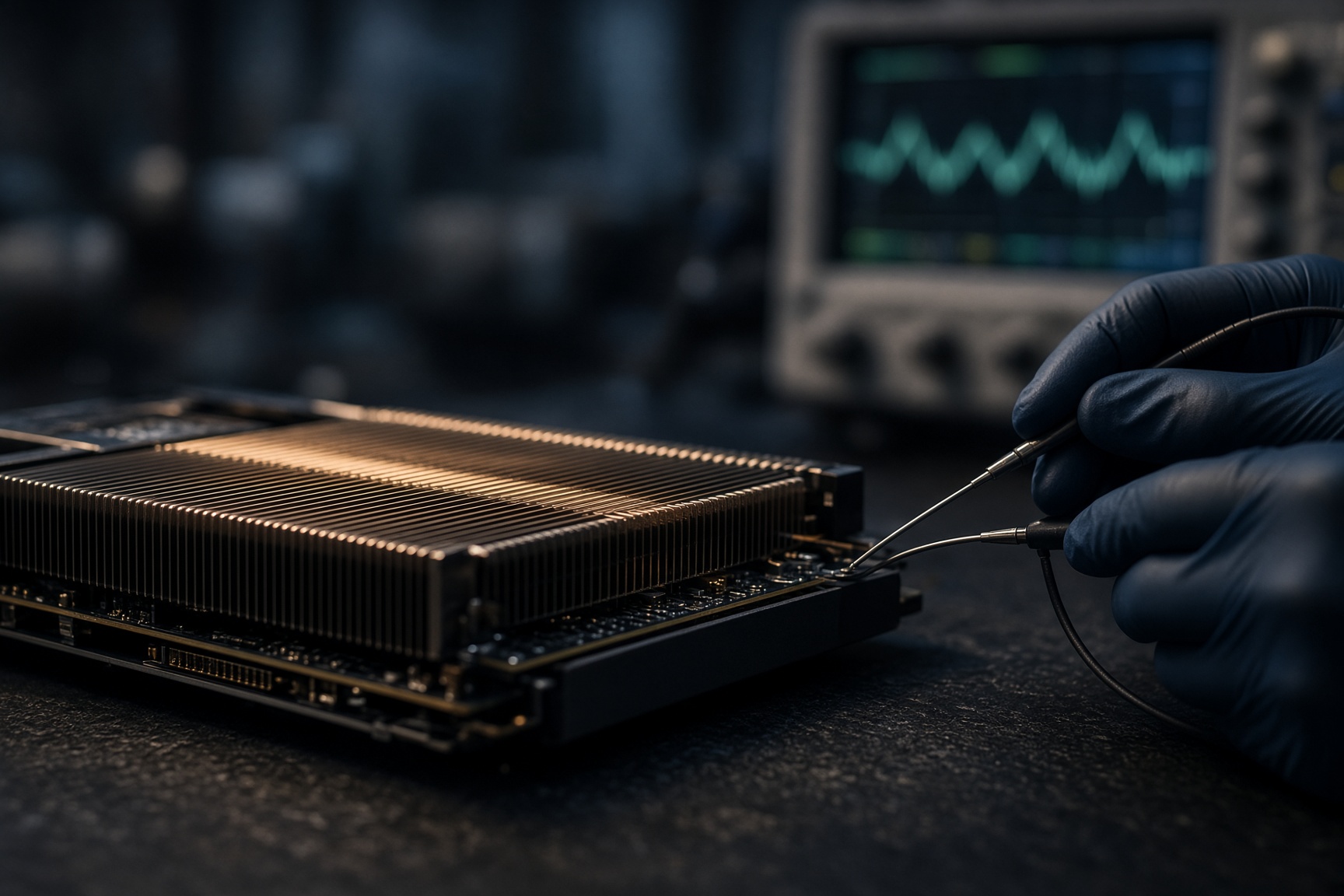
Rigorous hardware validation evaluates systems across three sequential domains: performance, data integration, and policy controls. Each evaluation reflects real-world operational stress rather than idealized test conditions, systematically retiring procurement risks.
Performance validation measures latency distributions, sustained throughput, and memory consumption under realistic enterprise workload shapes. Standard industry benchmarks are designed to compare hardware across vendors, not to expose the failure modes of proprietary workloads. Query distributions containing complex regulated requests, concurrency spikes driven by quarter-end financial closing, and long context windows created by actual users reveal whether recommended hardware configurations are genuinely sufficient. Empirical stress testing transforms hardware sizing from speculative vendor estimates into verifiable engineering measurements.
Data validation evaluates model behavior against actual data lineages, heterogeneous repositories, and production access controls. Models that excel on curated sample datasets often degrade when processing complex cross-departmental queries requiring unindexed records. The objective of data validation is to identify required data engineering, lineage tracking, and permission structures before capital allocation. This guarantees that production model behavior is empirically proven rather than projected.
Control validation verifies system architecture against enterprise network security policies and governance approval gates. Because infrastructure operates entirely inside the organization’s private network, sensitive data and proprietary models remain strictly within defined institutional boundaries. Validation confirms that user access patterns, autonomous agent sandboxing, and release gates function reliably under load. Identifying architectural friction early prevents compliance failures and operational disruptions.
The outcome of this validation is a tested prototype whose physical hardware requirements, operational cost profile, and throughput limits directly substantiate the procurement plan. Capital expenditure matches verified technical necessity. Hardware is neither over-provisioned based on vendor reference architectures nor under-provisioned through theoretical optimism. Capital commitments are anchored to empirical measurements on physical hardware, while unneeded expenditures are avoided through proven ceilings. This empirical evidence makes procurement decisions fully auditable and defensible.
Conducting validation on dedicated in-house GPU infrastructure, rather than metered cloud instances or vendor test benches, ensures objective findings. Metered cloud platforms create financial incentives for oversized architectures, while vendor test environments are engineered to showcase peak benchmark scores. Dedicated hardware configured to mirror the client’s on-premises network architecture operates with no structural bias. It exposes the operational boundaries that emerge only under physical hardware constraints and authentic enterprise traffic, producing defensible sizing recommendations.
Building and Validation is the stage where an approved strategic roadmap transitions into defensible physical infrastructure. It is also where unviable technical paths are eliminated before capital deployment. Unworkable approaches are retired based on empirical test data rather than rationalized as educational setbacks. When presented with validation data from physical hardware testing, leadership approves capital expenditure with clarity and confidence.